
OpenAI announced ChatGPT Wallet on Friday, November 13, 2026. It gives agents in ChatGPT Work, Codex, and dots a way to help complete purchases, but users still review and approve each transaction before checkout.
That approval step is the part to watch. The wallet moves an agent closer to taking action in the real world, while keeping a person in the payment loop.
#TL;DR
- What it is: A wallet that lets ChatGPT agents help with purchases using a payment token instead of sharing the user’s actual card details.
- Who released it: OpenAI announced ChatGPT Wallet on Friday, November 13, 2026.
- Who should care: People building or using AI agents that take actions, and anyone evaluating how those agents should handle payments and personal data.
#What’s new
ChatGPT Wallet is a payment feature, not a new model. OpenAI says agents in ChatGPT Work, Codex, and dots can help users decide what to buy and complete a purchase with the user’s approval.
At launch, the feature is available to a limited number of U.S. ChatGPT Pro subscribers aged 18 or older, using a U.S.-issued Visa, Mastercard, or American Express card. That’s a narrow rollout, not general availability. The announcement doesn’t specify a price for the wallet or changes to ChatGPT subscription pricing.
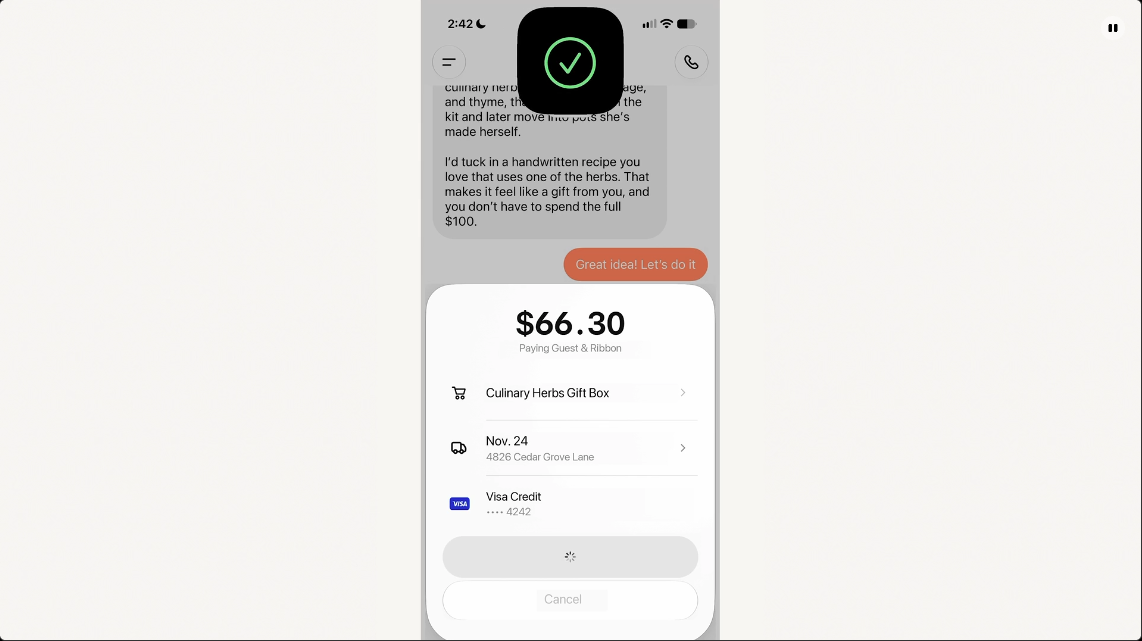
Users add an eligible card once, then ask an agent to help with a purchase. Before checkout, they can review the items, total, and selected card. They approve with a security check such as Face ID or a fingerprint, which creates a transaction record.
OpenAI says the wallet uses a payment token, a substitute for the actual card details. The token is used to charge the selected card, so the card number isn’t shared with the agent or merchant. The merchant receives the information needed to fulfill the order, such as the shipping address and contact details.
The feature is designed to preserve card rewards and protections, including the ability to dispute a transaction. Those familiar card protections matter: an agent-assisted checkout still needs a way to handle mistakes or unauthorized charges.
Warning
The agent can help prepare a purchase, but the user’s review and security approval are still required before checkout. The announcement doesn’t describe spending limits or category restrictions as available at launch.
The basic flow looks like this:
sequenceDiagram
    participant User as "User"
    participant Agent as "ChatGPT agent"
    participant Wallet as "ChatGPT Wallet"
    participant Merchant as "Merchant"
    User->>Agent: Ask for help with a purchase
    Agent->>User: Show items and total
    User->>Wallet: Approve with security check
    Wallet->>Merchant: Submit purchase using payment token
    Agent->>Merchant: Provide fulfillment details
#How it compares
OpenAI’s announcement and TechCrunch’s report provide limited detail about competing products or standard checkout flows. The comparison below sticks to what those reports establish, rather than assuming the products work the same way.
| Option | What the reports say | What’s not established |
|---|---|---|
| ChatGPT Wallet | ChatGPT agents can help complete purchases with user review and approval. | Availability beyond the limited launch group and supported retailers. |
| Instinct | TechCrunch reports that it also supports purchases on a user’s behalf. | Its approval steps, payment protections, and rollout details. |
| Direct merchant checkout | ChatGPT Wallet is intended to help with agent-assisted checkout. | A detailed comparison of checkout steps or protections. |
The meaningful distinction isn’t simply that an agent can shop. It’s whether the person can see what will be bought, understand the total, and approve the payment before it happens. OpenAI describes those checks for Wallet, but the available reports don’t provide enough detail for a security comparison with other agent tools.
#Try it yourself
There’s no public Wallet API or developer integration described in the announcement, so this example does not connect to ChatGPT Wallet or make a payment. It demonstrates a basic approval gate for an agent workflow: show the purchase details first, and continue only after an explicit yes.
Save this as quickstart.py and run it with Python 3:
item = "Wireless keyboard"
total = "$79.00"
card = "Visa ending in 4242"

print(f"Review purchase: {item}")
print(f"Total: {total}")
print(f"Payment card: {card}")

approved = input("Approve this purchase? Type yes: ").strip().lower() == "yes"

if approved:
    print("Approval recorded. No payment was made by this demo.")
else:
    print("Purchase cancelled.")
On approval, the output ends with Approval recorded. No payment was made by this demo. That last sentence is deliberate: user approval is a control point, but a real integration also needs a payment processor, secure credential handling, and a way to record the transaction. The announcement doesn’t document an API for those tasks.
#When to use it (and when not to)
- Consider it if you’re an eligible U.S. ChatGPT Pro subscriber and want an agent to help with a purchase while you review the final items and payment.
- Consider it as a product-design reference if you’re building agent workflows that need user approval before a consequential action.
- Don’t assume it’s available to you yet. OpenAI’s initial rollout is limited, and eligibility includes age, location, subscription, and card requirements.
- Don’t treat approval as a complete safety system. A review screen helps, but users still need to recognize incorrect items, totals, or fulfillment details.
- Don’t plan an integration around an undocumented API. The announcement describes a consumer-facing wallet, not a public developer interface.
#Limitations and open questions
The rollout is deliberately limited, according to the reporting, so OpenAI can test and improve the feature before making it more widely available. That leaves basic availability questions open: which users and retailers will be supported next, and how quickly access may expand.
OpenAI says it plans to add controls such as spending limits and rules for purchase categories or time periods. Those could let users pre-approve some purchases for more autonomous handling, but the reports describe them as future plans, not launch features.
Retailer support is another constraint. TechCrunch reports that some retailers are blocking AI agents from their sites, which could limit where agent-assisted shopping works. OpenAI has also published a Commerce Partner Playbook for retailers that want to support customers using agents. Neither the announcement nor the report provides a full list of supported merchants.
#Check your understanding
Quick check
What happens before a ChatGPT Wallet purchase is completed?
Show answer
Answer: The user reviews the purchase and approves it with a security check.
The reported flow requires user review and approval, and uses a payment token instead of sharing actual card details.
#FAQ
Can anyone use ChatGPT Wallet today?
No. The initial rollout is limited to some U.S. ChatGPT Pro subscribers aged 18 or older with an eligible U.S.-issued card.
Does the agent see my full card number?
OpenAI says the wallet uses a payment token so the user’s actual card details aren’t shared with the agent or merchant.
Can I set spending limits now?
Not according to the launch reporting. OpenAI plans to add spending limits and other purchase rules in the future.
#What I’d do
For users who get access, I’d treat Wallet as a supervised checkout assistant, not an autonomous shopping system. Review the item, total, shipping information, and card before approving. For developers, the useful design lesson is simpler: agents that can spend money need an explicit approval boundary, and the available announcement doesn’t yet provide enough detail to build against Wallet itself.
#Key takeaways
- ChatGPT Wallet brings user-approved purchases to agents in ChatGPT Work, Codex, and dots.
- OpenAI announced it on Friday, November 13, 2026, with a limited U.S. rollout.
- The wallet uses a payment token rather than sharing actual card details with the agent or merchant.
- Spending limits and broader retailer support remain open areas, not confirmed launch capabilitie




Comments
No comments yet. Start the conversation.